Thursday, November 26, 2026

Mārama (2025) Spoiler-free Film Review


"Walk backwards into your future"


Content warning: 
While not touched upon much in this review, Mārama contains themes of racism, incest, colonialism, homophobia, child and parent death, decapitation, and some incredibly brutal imagery - especially at the end. Take care of yourselves and proceed with caution when viewing this film. 


 So like many other people, I first came into awareness of this film by seeing a clip or screenshot of the haka scene about halfway through the movie. Mārama is a gothic film set in the mid 1800s about a Maori woman summoned to a manor in England by a letter from someone claiming to have answers about her family and her past. In true gothic fashion, she is pulled into something much more dark and twisted while uncovering the truth. 

Mary Stevens (played beautifully by Ariāna Osborne) arrived is Whitby, only to be abandoned by her carriage driver and found by a maid named Peggy, who brings her to Wawsker Manor, owned by Nathanial Cole (Toby Stephens who is here playing a whaler and not a legendary pirate captain.) Cole is decidedly sparse at doling out answers for her. He invites her to stay the night in his manor and while wandering the halls in true gothic fashion, Mary looks into a mirror only to have her haggard reflection scream at her in agony and rage. 
One detail I found interesting is that the scream itself is not edited or altered in anyway. It does not sound supernatural. There's no other-worldly echo or enhanced sound. It is just a raw and primal scream of anger. As if the woman had been standing in the hallway right beside her.  

This the first of many visions Mary begins having while in and around the manor. Throughout the film she (and we) are shown scenes of someone identical to her, imprisoned and bloody locked away somewhere. It is unclear at first who or what we are seeing. Are these future scenes? Something that happened in the past? Is this Mary's fate - or an ancestor who resembled her? The visions become what drives her to seek out more answers as the movie goes on, led like Alice following the white rabbit further and further towards the film's inevitable resolution. 

The next morning, Cole tells Mary that the man who summoned her to Whitby, Thomas Boyd, had been a close friend and employee of his, and offers her a job as a governess to his granddaughter. It isn't until after Mary refuses multiple times, claiming she needs to find Boyd and learn what he knows, that Cole informs her that Boyd has died of the pox. Mary tries to leave and Cole once again insists she stay in the manor, pleading on behalf of his granddaughter, Anne. Her father is a drunkard and her mother is dead. She needs someone to look after her. Mary refuses until Cole begins speaking to her in Maori and claims he's always had a deep admiration and respect for her people and her culture. We find out just how deep that "admiration" goes later.

Upon meeting Anne, Mary is admittedly charmed by her and agrees to take the job, though there still seems to be a lot that Cole is keeping from her about just how much he knows about her. Anne shows her around the gardens, including a Maori meeting house in the middle of a hedge maze that can only be accessed by a small shed that can be turned completely around (this provides some wonderfully spooky imagery later on.) When Mary approaches the  building, she's struck by another vision - this one of a woman in traditional Maori clothing singing at the ocean's edge. She tells Mary to find  the answers, while Mary's vision of herself begins bleeding from a cut across her throat. The viewers can already tell this is foreshadowing, but we do not yet know exactly what kind. 

 Predictably, when Mary confronts Cole about just why he has this building in his garden, he is incredibly cagey - once again claiming his respect for the Maori and wanting to care for and preserve the building himself. This becomes a reoccurring theme for him. Cole claims to have intense respect for Maori culture, and he's taught his granddaughter the same. But they way they approach it - especially when speaking to an actual Maori woman - feels like they're trying to teach her about it, acting like they know more about it than she would. Mary was orphaned and raised by a French family, but grew up in Aotearoa, experiencing the culture by being part of it.

When Mary pushes him further, he reveals that Anne's mother was Mary's twin sister, Emilia, who died in childbirth. Mary is of course furious that he kept this from her as more and more cracks in Cole's story begin to appear. She later finds a photograph of a pregnant Emilia dated only a year previous. Mary begins to suspect her sister is still alive and that the visions she's been having are leading Mary to her. Mary takes on her Maori name ("My name is Mārama") and is determined to learn the truth, one way or another.

That night, Cole has a party for his birthday (y'know, like a five year old) where Jack Fenton, a friend of his (an incredibly vulgar-mannered white man sporting Maori tattoos) performs a racist caricature of the Maori culture. Cole allows this and seems incredibly entertained. So much for that "respect and reverence" he had for Mary's culture. This is where we get the Haka scene - Mārama shatters a glass and challenges Jack to fight, shouting "How dare you wear the markings of my ancestors - I'll rip the face off of you!" 
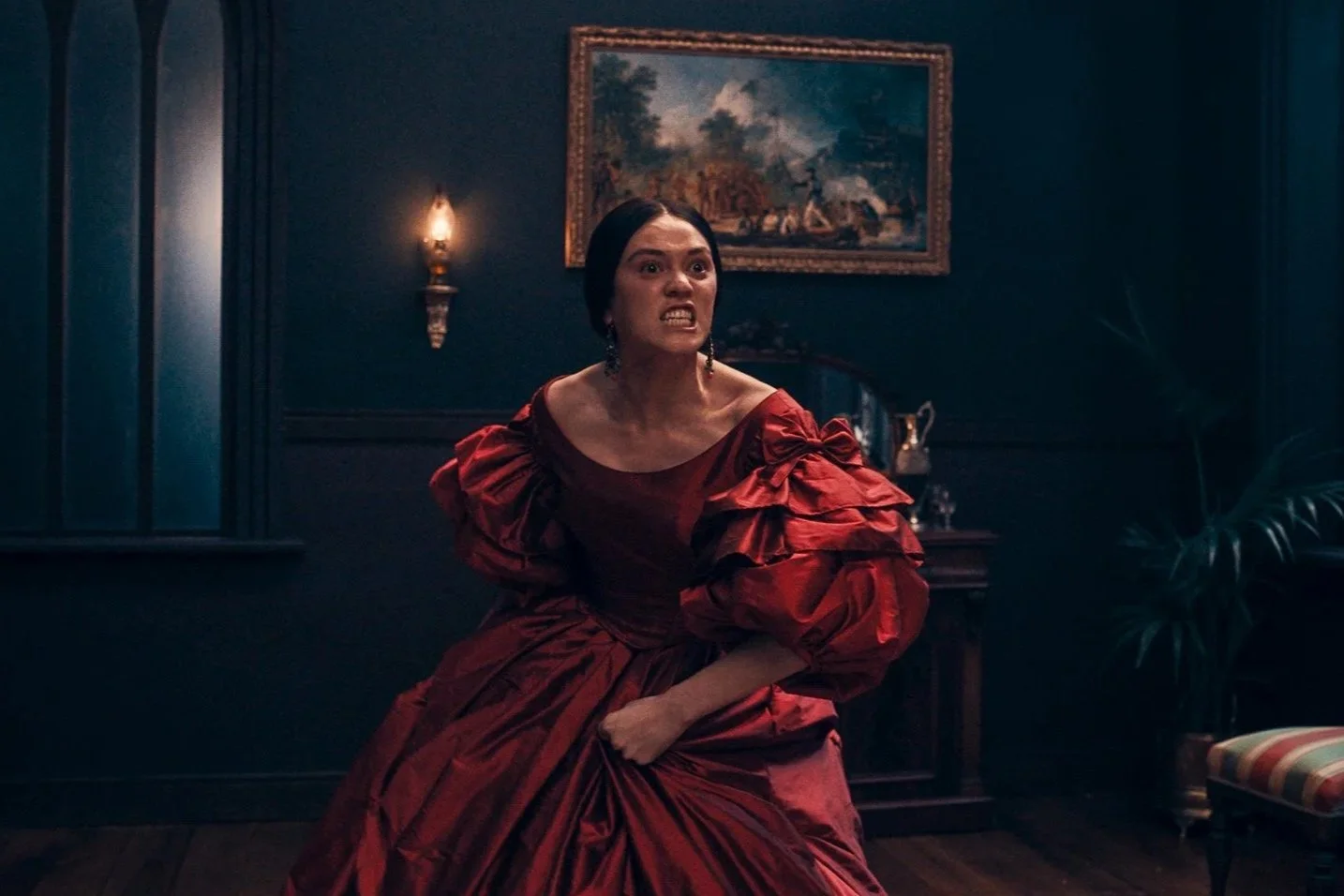
Mārama' Director Taratoa Stappard on Making the First Māori Gothic Horror  Film — PHANTASMAG
This is absolutely the face of someone who will rip the face off of you and feel no two ways about it. 10/10 No notes.


The gathered guests cheer and applaud, thinking she's part of the performance, but only Cole and Peggy seem to register her fury and just how serious she is. Things are coming to a head and the climax of the film is fast approaching. Everything will soon be revealed. 


 In true Gothic fashion, Mārama is a slow build, creating a tense atmosphere and slowly revealing secrets as it goes along, leading both the central character and the viewer down a dark and winding tunnel into truly horrific and depraved ends. Throughout the movie there is an echoing phrase we hear over and over, "Walk backwards into your future." Mārama must uncover her past in order to move forward - no matter the darkness is plunges her into. As viewers, all we can do is be led along with her and hope we come out intact at the end. 


Wednesday, November 25, 2026

"With Stars in her Eyes" - a dnf review


 With Stars in Her Eyes by Andie Burke. 


So, for full transparency, I dnf-ed this about fifty pages before the end of the book because it was actually putting me in a bad mood. This one had been on my TBR shelf for a while because both the cover and the cozy premise got my attention, but unfortunately I didn't care for it by the end...hence putting it down less than a hundred pages before the end. 

Before I get into the bulk of the review, I just need to point out that the writing over all was pretty repetitive and kind of sloppy in the early chapters and only seemed to get worse as it got closer to the ending. In addition, the author didn't seem to really want to write half of it. We got either partial scenes or just time jumps and *maybe* would hear about what had transpired. I'll dive deeper into that later...


The good:
 
As I said, I liked the premise and a lot of the earlier dialogue in the beginning of the book, and was super interested in Courtney's storyline - I honestly could have just read a full novel focused just on her. I thought much of the dialogue in the first few chapters was also pretty funny - especially involving the animal encounters.
I was partially invested in Thea's storyline as well, even if not as much. Unfortunately nothing really seemed to come of that. She has all of these anecdotes about her family taking advantage of her photography skills and deliberately leaving her out of everything else, as well as her insanely overbearing mother calling her up to eight times a day starting at five AM. Still, we never see her interact with them outside of a couple of phone calls, and all of the events she had to take pictures at happen off page. 

 - which leads into the things that started to stick out to me more and more...

The not-so-good: 

The writing in this was very sloppy throughout and only increased as the book went on. I first noticed something felt off when Thea kept talking about all of these events she had to go photograph for her family - only to have them completely glossed over and never shown once. "Show don't tell" is not the iron-clad rule it's treated as - but it still needs to be followed some of the time. More than that, if you're not going to show me what's going on on the page itself, you need to at least fully explain what happened. 

In the book's final act, we get multiple chapters in a row that end with a cliffhanger that isn't picked up or revealed until several chapters later - if it is at all. Courtney is shown a "bombshell" on her friend's phone - the reveal of which is avoided (despite this book being written in the first person) until Thea finds out several chapters later - and even then, we can only infer that that is the bombshell in question. 
Between that, Thea's friend Marshall shows up to her studio with red eyes looking devastated - but it's never outright stated what happened. The next time we see Marshall he's in his pub (which I kept getting mixed up with the *other* pub they were frequenting in the same chapter that was also referred to as "the pub") drunkenly sitting against the wall moping. What happened? It's never directly stated, but Thea mentions a locksmith, Marshall mentions "his former business partner" (who has never been mentioned before) and there is talk of "they didn't take ___" so I'm fairly sure his pub got robbed? But again, none of that is established. And this sort of thing happens over and over and I got fed up with feeling like I was trying to piece together the DaVinci code just to figure out what's happening in this book.

The bad:
 
I hate Thea.
This is a character that describes herself as being "too nice" and "too sweet" and then when the first snag in her relationship she blows up and acts like a huge bitch. I found myself hoping she and Courtney wouldn't end up together with the way Courtney was being treated....which probably isn't the desired outcome when writing a romance novel.


Basically Thea flips out and climbs out of Courtney's window after a shrooms induced, three-day, fuck session (I don't know - that scene isn't actually in the book) because her bandmate showed up at her house and Thea realized who Courtney is. Thea is a huge fan of Courtney's stage persona, Kestral, and even seems to use that against her, in a way. She angrily shouts at her that she listened to all of her music and was a huge fan. As though Courtney wanting some goddamn privacy was done to spite Thea personally.

As if this isn't enough, Thea doesn't even seem to know why she's angry. She seems mad that Courtney wants part of her life to be separate. And then proceeds to get upset any time there's something about Courtney she doesn't know yet because she's only known this woman for three months.

Thea later says that everything happening with Courtney is "too much (when she's the one who made it a thing), especially with everything with Mitchell (which, again... we never get the full story of either)"

 - but what she's doing is blaming Courtney for her being in a bad mood and takes everything as a slight against her.
Courtney tells her she was being blackmailed by her horrible ex-husband  and that she only told her closest friends the night before, Thea's first thought is "oh - another thing she didn't tell me" She's known this woman for three months - most of that wasn't even on the page - and she thinks she deserves every detail about this woman's life, apparently. 
- Also, she would have been told if she hadn't blown Courtney off to throw her own temper tantrum.

 Even after trying to patch things up with Courtney (where Courtney blames herself for everything Thea is pissed off about) she still considers everything she doesn't know as "lying by omission."
 Think I'm joking? The page that made me dnf the book involved Thea finding out it was Courtney's birthday and after clarifying, she thought "Another omission" Not "another lie" or even "Another lie by omission" She's mad at her not-even-girlfriend because she hasn't told her ....what? Every detail about herself? After knowing her for (maybe?) three months*? 

(*The passage of time in this book is another thing that made me want to put my head through drywall. I never know when it is in this book. It's a blizzard in one scene and then in the next chapter a character is coming back from the beach with a tan. A "vacation" is mentioned once or twice, but again, we don't see it happen and nothing establishes what month it is - just that "three months/weeks" have gone by.)

My theory (and I don't know if this is ever realized in the book's finale because I stopped reading it) is Thea was pissed off that she bought tickets to see Kestrel's band live, and not only did something come up and she couldn't go, but Courtney's chronic migraines made it so that she had to post-pone the tour. The first scene we get of Thea, she's in a pissy mood because she's stuck working the night of the concert she couldn't go to ... which was also canceled and didn't happen (as far as I could tell) So what we're seeing is Thea still being mad about her plans getting wrecked and finally being able to lash out at the one who wrecked it for her.

What happened after that - I have no idea. I had to stop reading because, as mentioned, all of this put me in a god-awful mood. I'm choosing to believe that Courtney said to hell with this awful woman and started touring again as much as her chronic migraines would allow, sued the hell out of her ex, and achieved her dreams, finding someone much better than fucking Thea and I don't want anyone to tell me otherwise