 |
| "Walk backwards into your future" |
Content warning:
While not touched upon much in this review, Mārama contains themes of racism, incest, colonialism, homophobia, child and parent death, decapitation, and some incredibly brutal imagery - especially at the end. Take care of yourselves and proceed with caution when viewing this film.
So like many other people, I first came into awareness of this film by seeing a clip or screenshot of the haka scene about halfway through the movie. Mārama is a gothic film set in the mid 1800s about a Maori woman summoned to a manor in England by a letter from someone claiming to have answers about her family and her past. In true gothic fashion, she is pulled into something much more dark and twisted while uncovering the truth.
Mary Stevens (played beautifully by Ariāna Osborne) arrived is Whitby, only to be abandoned by her carriage driver and found by a maid named Peggy, who brings her to Wawsker Manor, owned by Nathanial Cole (Toby Stephens who is here playing a whaler and not a legendary pirate captain.) Cole is decidedly sparse at doling out answers for her. He invites her to stay the night in his manor and while wandering the halls in true gothic fashion, Mary looks into a mirror only to have her haggard reflection scream at her in agony and rage.
One detail I found interesting is that the scream itself is not edited or altered in anyway. It does not sound supernatural. There's no other-worldly echo or enhanced sound. It is just a raw and primal scream of anger. As if the woman had been standing in the hallway right beside her.
This the first of many visions Mary begins having while in and around the manor. Throughout the film she (and we) are shown scenes of someone identical to her, imprisoned and bloody locked away somewhere. It is unclear at first who or what we are seeing. Are these future scenes? Something that happened in the past? Is this Mary's fate - or an ancestor who resembled her? The visions become what drives her to seek out more answers as the movie goes on, led like Alice following the white rabbit further and further towards the film's inevitable resolution.
The next morning, Cole tells Mary that the man who summoned her to Whitby, Thomas Boyd, had been a close friend and employee of his, and offers her a job as a governess to his granddaughter. It isn't until after Mary refuses multiple times, claiming she needs to find Boyd and learn what he knows, that Cole informs her that Boyd has died of the pox. Mary tries to leave and Cole once again insists she stay in the manor, pleading on behalf of his granddaughter, Anne. Her father is a drunkard and her mother is dead. She needs someone to look after her. Mary refuses until Cole begins speaking to her in Maori and claims he's always had a deep admiration and respect for her people and her culture. We find out just how deep that "admiration" goes later.
Upon meeting Anne, Mary is admittedly charmed by her and agrees to take the job, though there still seems to be a lot that Cole is keeping from her about just how much he knows about her. Anne shows her around the gardens, including a Maori meeting house in the middle of a hedge maze that can only be accessed by a small shed that can be turned completely around (this provides some wonderfully spooky imagery later on.) When Mary approaches the building, she's struck by another vision - this one of a woman in traditional Maori clothing singing at the ocean's edge. She tells Mary to find the answers, while Mary's vision of herself begins bleeding from a cut across her throat. The viewers can already tell this is foreshadowing, but we do not yet know exactly what kind.
Predictably, when Mary confronts Cole about just why he has this building in his garden, he is incredibly cagey - once again claiming his respect for the Maori and wanting to care for and preserve the building himself. This becomes a reoccurring theme for him. Cole claims to have intense respect for Maori culture, and he's taught his granddaughter the same. But they way they approach it - especially when speaking to an actual Maori woman - feels like they're trying to teach her about it, acting like they know more about it than she would. Mary was orphaned and raised by a French family, but grew up in Aotearoa, experiencing the culture by being part of it.
When Mary pushes him further, he reveals that Anne's mother was Mary's twin sister, Emilia, who died in childbirth. Mary is of course furious that he kept this from her as more and more cracks in Cole's story begin to appear. She later finds a photograph of a pregnant Emilia dated only a year previous. Mary begins to suspect her sister is still alive and that the visions she's been having are leading Mary to her. Mary takes on her Maori name ("My name is Mārama") and is determined to learn the truth, one way or another.
That night, Cole has a party for his birthday (y'know, like a five year old) where Jack Fenton, a friend of his (an incredibly vulgar-mannered white man sporting Maori tattoos) performs a racist caricature of the Maori culture. Cole allows this and seems incredibly entertained. So much for that "respect and reverence" he had for Mary's culture. This is where we get the Haka scene - Mārama shatters a glass and challenges Jack to fight, shouting "How dare you wear the markings of my ancestors - I'll rip the face off of you!"
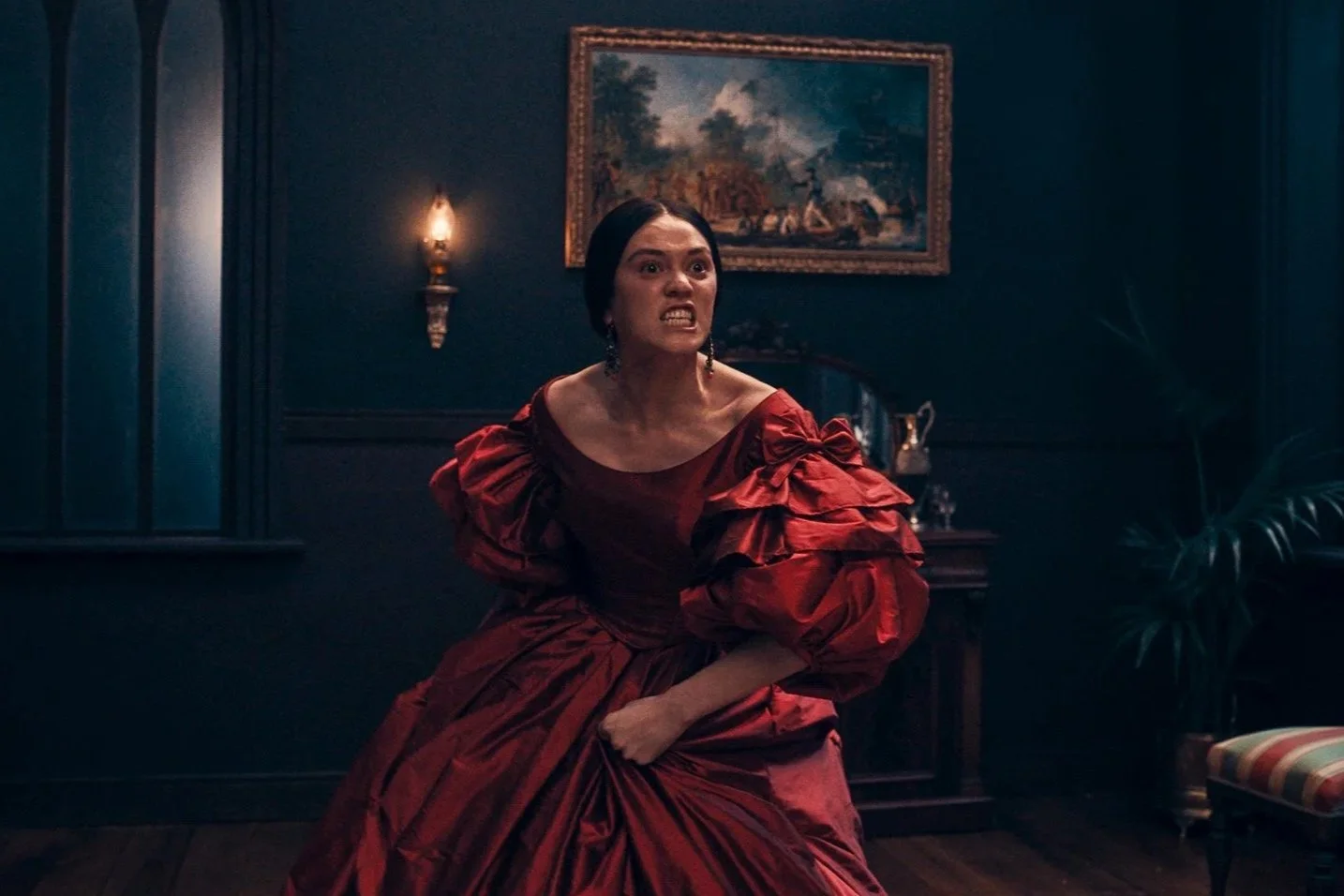 |
| This is absolutely the face of someone who will rip the face off of you and feel no two ways about it. 10/10 No notes. |
The gathered guests cheer and applaud, thinking she's part of the performance, but only Cole and Peggy seem to register her fury and just how serious she is. Things are coming to a head and the climax of the film is fast approaching. Everything will soon be revealed.
In true Gothic fashion, Mārama is a slow build, creating a tense atmosphere and slowly revealing secrets as it goes along, leading both the central character and the viewer down a dark and winding tunnel into truly horrific and depraved ends. Throughout the movie there is an echoing phrase we hear over and over, "Walk backwards into your future." Mārama must uncover her past in order to move forward - no matter the darkness is plunges her into. As viewers, all we can do is be led along with her and hope we come out intact at the end.


